



A panic attack can happen anywhere, while you’re driving down the 404, waiting in line at the grocery store, or sitting in a busy office on Main Street. When the “internal storm” hits, your brain loses touch with the present moment.
Grounding techniques are designed to anchor you back to reality. Here are five techniques specifically adapted for life in Newmarket, Ontario.
For more comprehensive strategies, refer to our Complete Guide to Managing Anxiety in Ontario.
1. The “Fairy Lake” Sensory Scan (5-4-3-2-1)
If you are near the Tom Taylor Trail or Fairy Lake, use the environment to interrupt the panic loop.
- Identify: 5 things you see (the bridge, a swan, a willow tree), 4 things you can feel (the wooden railing, your feet on the pavement), 3 things you hear (the fountain, distant traffic, birds), 2 things you smell (fresh grass, damp earth), and 1 thing you can taste (mint or water).
2. Temperature Shock: The “Main Street” Refresh
Panic attacks often involve a “hot flash” or feeling of suffocation. Sudden cold can “reset” your nervous system.
- The Technique: If you are near a local cafe or restroom on Main Street, splash ice-cold water on your face or hold a cold beverage against your wrists. The cold stimulates the vagus nerve, which signals your heart rate to slow down.
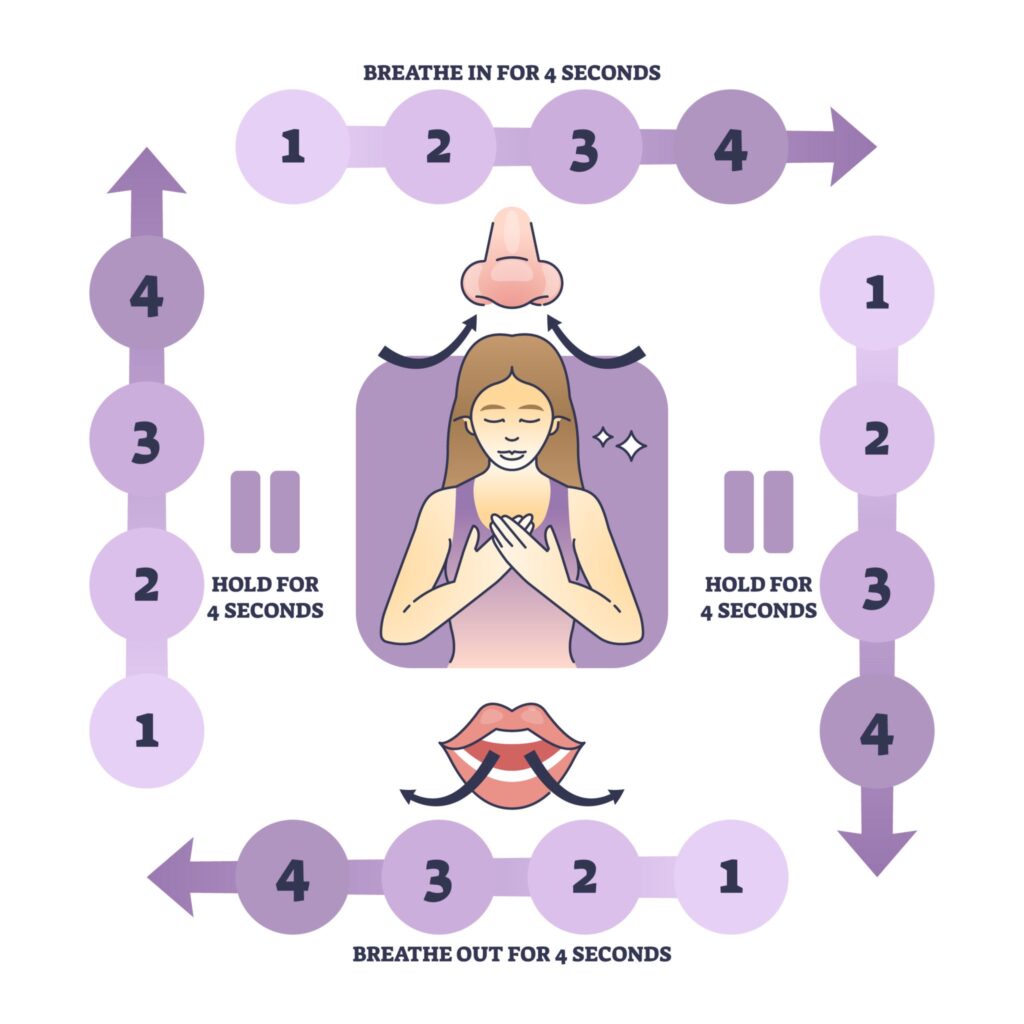
3. Square Breathing at Upper Canada Mall
In crowded spaces like a mall, panic can feel like “claustrophobia.” Square breathing (or Box Breathing) regulates your CO2 levels and stops hyperventilation.
The Technique: Inhale for 4 seconds, hold for 4, exhale for 4, and hold for 4. Use the square edges of a store window or a floor tile as a visual guide to follow the rhythm.
4. Heavy Feet (The “Canadian Shield” Anchor)
Panic makes you feel lightheaded or “floaty.” To counter this, you need to feel the weight of your body.
- The Technique: Stop walking and press your heels firmly into the ground. Imagine roots growing from your feet into the solid Ontario earth. Focus entirely on the sensation of the ground supporting your weight.
5. The “Red Item” Search
When your mind is racing with “What if?” thoughts, give it a boring, logical task to perform.
- The Technique: Look around your immediate environment and name every red item you see. A red stop sign on Davis Drive, a red jacket, a red car. This forces your brain’s prefrontal cortex to take back control from the emotional amygdala.
Local Support & Emergency Resources
If grounding isn’t enough and you need to speak with someone immediately in the Newmarket/York Region area:
- York Support Services Network (YSSN) Crisis Line: Call 1-855-310-COPE (2673). This is a 24/7 community crisis service available specifically for York Region residents.
- Southlake Regional Health Centre: If you are experiencing a medical emergency or a severe mental health crisis, the Emergency Department at Southlake (596 Davis Dr) is equipped to help.
- CMHA York Region and South Simcoe: Offers various programs and support groups for anxiety and mood disorders. Visit CMHA York Region.
- Newmarket Public Library: A “quiet zone” that can serve as a safe, low-stimulation environment if you need a place to recover after an attack.
Clinical Insight
“Newmarket residents often feel the ‘commuter squeeze’ that unique stress of balancing a quiet suburban life with a high-pressure GTA career. Panic is your body’s way of saying the pressure is too high. These grounding tools don’t just stop the attack; they remind your nervous system that you are safe in your own community.”