



The “Double ADHD” dynamic occurs when both the parent and the child are neurodivergent, leading to a household environment where executive function gaps and emotional dysregulation are often mirrored. Because ADHD has a high rate of genetic heritability estimated at roughly 70-80% this dynamic is incredibly common. While it presents unique challenges in organization and consistency, it also offers a profound opportunity for radical empathy and shared understanding that neurotypical families may never experience.
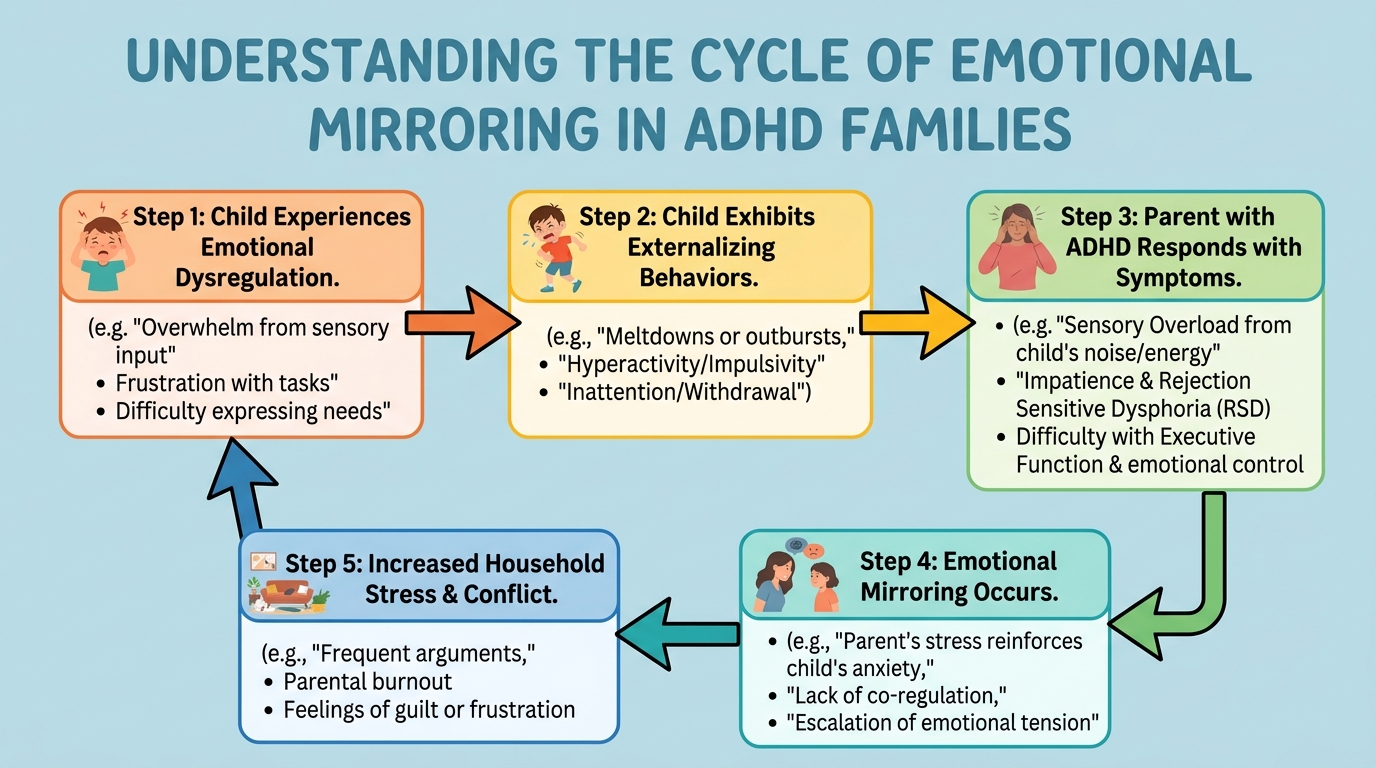
The Mirroring Effect: Why Emotions Escalate
In a Double ADHD household, “Emotional Contagion” is a daily reality. When a child has a meltdown due to sensory overload, the parent’s own ADHD nervous system may interpret that distress as a threat, triggering the parent’s “fight-or-flight” response.
- The Reflection: You see your own struggles with impulsivity or forgetfulness in your child, which can trigger intense feelings of guilt or “parental shame.”
- The Collision: Two people with executive dysfunction trying to navigate a high-stakes transition (like the morning school run) often results in “clashing” energies.
1. Co-Regulation: Stabilizing the “Big” Brain First
The gold standard of neuro-affirming parenting is co-regulation. You cannot settle a child’s nervous system if yours is currently on fire.
- The Oxygen Mask Principle: In a Double ADHD home, the parent’s self-regulation is the most important “chore” of the day.
- Shared Grounding: When things get heated, implement a “Family Reset.” This could be 5 minutes of low sensory input (lights off, soft music) that benefits both the parent’s and the child’s regulation needs.
2. Bridging the Executive Function Gap
If neither the parent nor the child “naturally” remembers where the keys are or when library books are due, you must stop relying on memory and start relying on Environmental Scaffolding.
- Shared Visual Systems: Use color-coded zones. If the “ADHD Parent” is responsible for lunches and the “ADHD Child” is responsible for shoes, use high-contrast floor tape or bins to mark exactly where those items live.
- Externalized Reminders: Use smart home devices (like Alexa or Google Home) to announce transitions. This removes the “nagging” element from the parent and puts the “demand” onto a neutral third party.
3. The Power of Shared Language
The greatest strength of the Double ADHD dynamic is that you know how their brain feels.
- Validate the Effort: Instead of saying “Why is this taking so long?”, you can say, “I know your brain is feeling ‘stuck’ right now. My brain gets stuck too. Let’s try a dopamine hit (like a quick song) to get us moving.”
- Unmasking Together: Creating a home where it is safe to be “distracted” or “high-energy” reduces the trauma of masking and builds a deep, resilient bond.
Clinical Support for Neuro-Complex Families
Managing a Double ADHD household is a marathon, not a sprint. At Inner Journey with Maria, we specialize in helping Ontario parents move away from the “Double Chaos” and toward a “Double Strength” framework. We provide clinical strategies that respect the neurobiology of both the parent and the child.
References
- Faraone, S. V., & Larsson, H. (2019). Genetics of Attention Deficit Hyperactivity Disorder. Molecular Psychiatry.
- CADDRA (Canadian ADHD Resource Alliance). (2024). ADHD and Family Dynamics. https://www.caddra.ca
- Barkley, R. A. (2020). Taking Charge of ADHD: The Complete, Authoritative Guide for Parents. Guilford Press.
- Chronis-Tuscano, A., et al. (2017). Parenting and ADHD: A Review of the Evidence and a Framework for Intervention. Clinical Child and Family Psychology Review.