



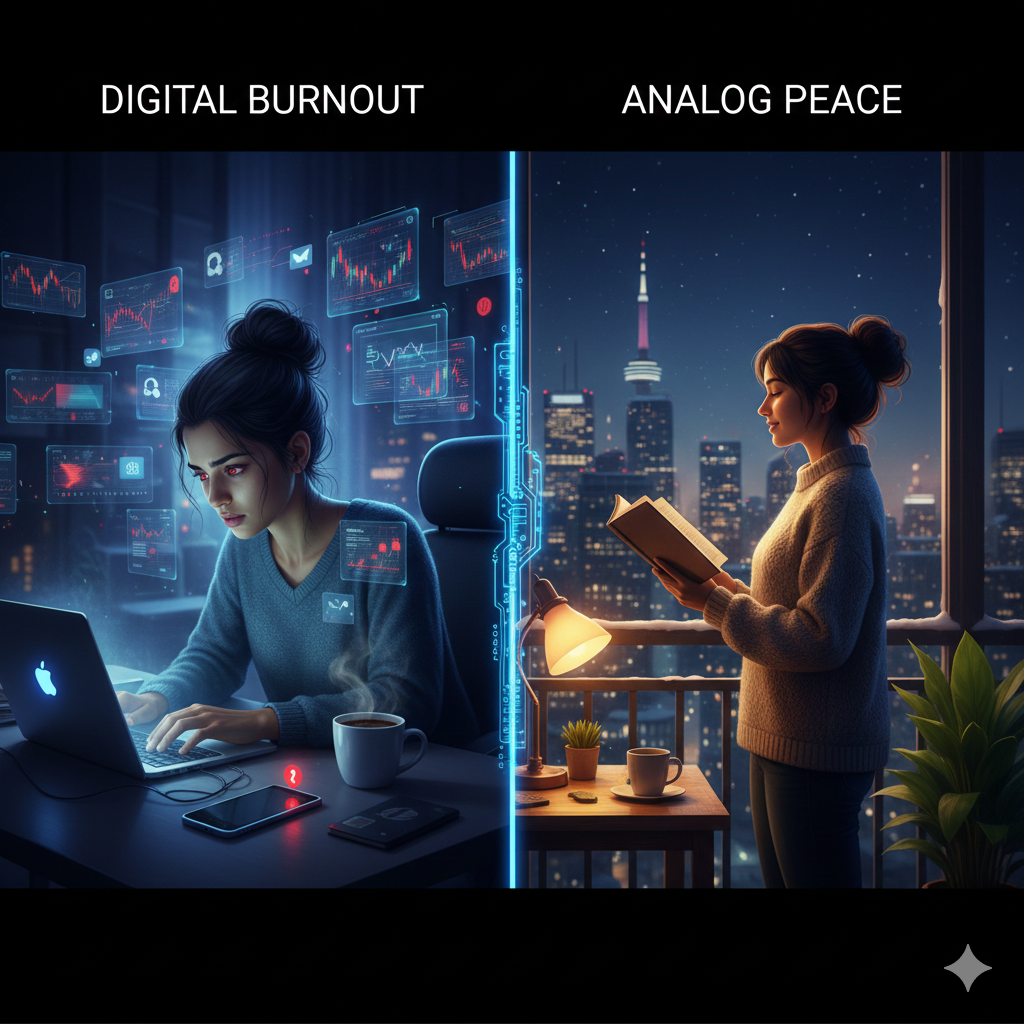
For professionals in the GTA and the Waterloo region, technology is both a tool for success and a source of significant stress. With the rise of asynchronous work and global teams, the “end of the workday” has become an obsolete concept for many.
Digital burnout occurs when the cognitive load of constant notifications, screen time, and “context switching” exceeds your brain’s ability to recover.
The Signs of Digital Fatigue
Unlike a physical injury, digital burnout creeps up slowly. Look for these “Tech-Stress” markers:
- The “Phantom Ping”: Feeling your phone vibrate even when it isn’t in your pocket.
- Decision Fatigue: Feeling overwhelmed by simple choices (like what to eat for dinner) because you’ve spent all day making high-stakes digital decisions.
- Eye Strain & “Brain Fog”: Difficulty focusing on long-form text after hours of scrolling Slack or Jira.
- Increased Irritability: Snapping at loved ones because your “sensory cup” is overflowing from blue light and noise.
Why the “Waterloo-Toronto Corridor” is Unique
The concentration of tech talent in Southern Ontario creates a “comparison trap.”
- The “Always-On” Expectation: In a competitive market, there is a perceived pressure to respond to messages at 10:00 PM to prove “commitment.”
- Commuter Anxiety: For those splitting time between Toronto and Waterloo, the “dead time” on the GO Train or Highway 401 is often filled with more screen time, denying the brain a transition period between work and home.
Reclaiming Your Analog Brain
You don’t have to quit your job to solve digital burnout. It requires Digital Hygiene.
The “20-20-20” Rule
To combat physical eye strain and the associated tension headaches: every 20 minutes, look at something 20 feet away for at least 20 seconds. This simple reset tells your nervous system you aren’t in a “locked-in” stress state.
Use the “Working for Workers Act”
In 2021, Ontario became the first jurisdiction in Canada to require employers to have a written “Right to Disconnect” policy.
- Check your handbook: Know what your company’s official stance is on after-hours communication. Most employees in the GTA are legally protected from being penalized for not answering emails after 6:00 PM.
Intentional “Blackouts”
Designate “No-Tech Zones” in your home, specifically the bedroom and the dinner table. Using an analog alarm clock instead of your phone prevents the “first-thing-in-the-morning” dopamine spike from notifications.
External & Medical Resources in Ontario
- Ontario Ministry of Labour: Your Right to Disconnect – FAQ.
- CAMH: Information on Technology Addiction and Mental Health.
- Workplace Safety & Prevention Services (WSPS): Mental Health and Burnout Resources for Employees.
- Distress Centres of Greater Toronto: 24/7 support for those feeling overwhelmed. Call 416-408-4357.
- Mindful Employer Canada: Resources for navigating tech-related stress in the Canadian workplace. Visit Mindful Employer.
Clinical Insight
“In my practice, I see many tech professionals who feel ‘guilty’ for being stressed because they have high-paying, remote-capable jobs. But your brain doesn’t care about your salary; it cares about safety. Constant notifications keep your amygdala in a state of ‘high alert’ that is biologically identical to being hunted. You aren’t weak; you’re over-stimulated.”