


If you have ever felt a sudden wave of terror or a mounting sense of dread that made your heart race, you know how frightening the experience can be. In the heat of the moment, it feels like a medical emergency.
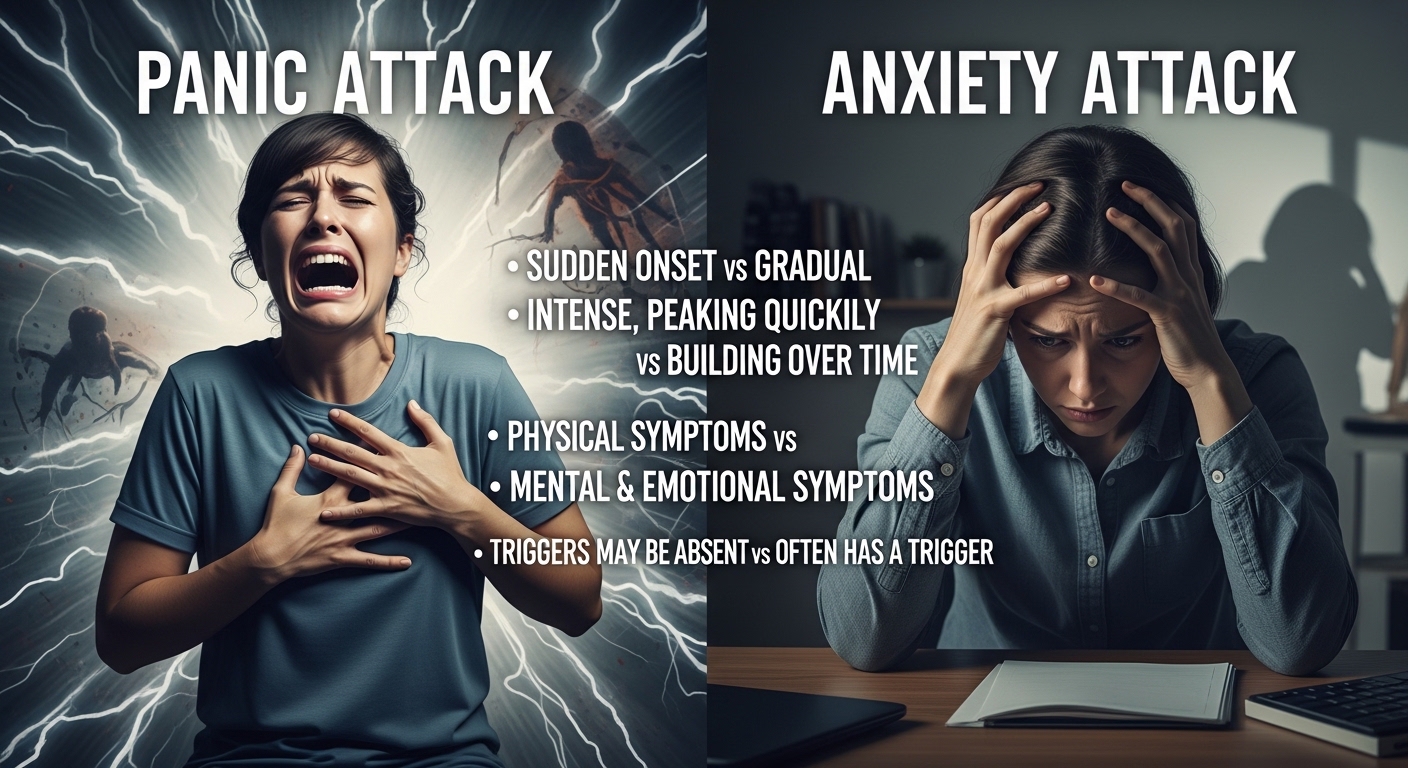
While people often use the terms “panic attack” and “anxiety attack” to mean the same thing, they are actually distinct experiences with different triggers and “shapes.”
The Differences at a Glance
The easiest way to tell them apart is by looking at how they start and how long they last.
Feature | Panic Attack | Anxiety Attack |
Onset | Sudden, “out of the blue.” | Gradual, builds up over time. |
Intensity | Intense, overwhelming terror. | Moderate to high distress. |
Duration | Peaks within 10 minutes; ends quickly. | Can last for hours, days, or weeks. |
Symptoms | Feeling of dying, “going crazy,” or chest pain. | Muscle tension, irritability, disturbed sleep. |
Clinical Status | Defined in the DSM-5. | A colloquial term for “escalated anxiety.” |
Recognizing the Symptoms
The “Sudden Storm”: Panic Attacks
A panic attack is a short-circuit of the body’s “fight or flight” response. It often feels physical rather than mental.
- Heart Palpitations: Feeling like your heart is skipping beats or pounding.
- Shortness of Breath: Feeling like you can’t get enough air (hyperventilation).
- Derealization: Feeling like the world around you isn’t real or you are “outside” your body.
- Fear of Death: A genuine conviction that you are having a heart attack.
The “Slow Burn”: Anxiety Attacks
Anxiety attacks are usually linked to a specific stressor (like a deadline, a conflict, or an Ontario winter).
- Persistent Worry: A “loop” of negative thoughts you can’t turn off.
- Physical Restlessness: Fidgeting, pacing, or a “tight” feeling in the chest.
- Fatigue: Feeling drained after hours of high-alert thinking.
What to Do Right Now: Grounding Techniques
Regardless of which one you are experiencing, the goal is to bring your nervous system back to safety.
- The 5-4-3-2-1 Method: Look around and name 5 things you see, 4 things you can touch, 3 things you hear, 2 things you smell, and 1 thing you can taste.
- Box Breathing: Inhale for 4 seconds, hold for 4, exhale for 4, hold for 4. Repeat.
- The “Ice” Trick: Hold an ice cube in your hand or splash cold water on your face. The sudden temperature change “shocks” the vagus nerve and pulls you out of a panic loop.
External Resources & Emergency Support in Ontario
If you are currently in distress or these attacks are becoming frequent, use these Ontario-specific resources:
- ConnexOntario: Call 1-866-531-2600 for 24/7 support and to find local treatment services.
- Ontario Crisis Text Line: Text HOME to 741741 to connect with a crisis counselor.
- Telehealth Ontario: Call 811 (formerly Telehealth) to speak with a registered nurse if you are unsure if your symptoms are a medical emergency.
- CAMH (Toronto): If you are in the GTA, the CAMH Emergency Department (250 College Street) is open 24/7 for mental health crises.
- Postpartum Support International (Ontario Chapter): Find local support here.
Clinical Insight
“One of the most powerful things I tell my clients in Ontario is that a panic attack cannot kill you. It is a physical sensation of fear, but it is not a heart attack. Once you learn to ‘ride the wave’ of the 10-minute peak, the fear loses its power over you.”